What does flooring cost per square foot?
For the material alone, $1.13 to $16.79 per square foot on , median $3.99, from 1704 observations of 839 products from 8 manufacturers at 3 of the 7 US online retailers we track. A panel of sellers, not the flooring market. No installation labor is included in that figure or published anywhere on this site.
What one square foot costs
The range is wide for two reasons, and only one of them is about sellers. Half of the observations sit between $3.09 and $5.27; the quartiles are the part of this table to use if you want one number, because the two endpoints are the thinnest evidence on the page. The other reason is that the table pools constructions — floating vinyl (click / rigid core) had a median of $4.09, glue-down vinyl had a median of $3.09, loose-lay vinyl had a median of $3.79, engineered wood had a median of $7.89, laminate had a median of $3.99 — so if you already know which floor you are buying, the family figure is the one to use.
| Statistic | USD / sq ft | Evidence behind it |
|---|---|---|
| Lowest observed | $1.13 | 1 obs · 1 products |
| 25th percentile | $3.09 | 1704 obs |
| Median | $3.99 | 1704 obs |
| 75th percentile | $5.27 | 1704 obs |
| Highest observed | $16.79 | 2 obs · 2 products |
Basis: advertised online retail price, materials only. The $16.79 top rests on 2 observations and the $1.13 bottom on 1 — read the endpoints as the extremes they are, not as the shape of the market. Every product individually is on the observed prices table.
What a job of a given size costs
Multiply the area by the price and you get the wrong number, because nobody is billed for the area they measured. A waste allowance goes on first — 10% for a straight or staggered layout — and then flooring is sold in sealed boxes, so the order rounds up again to the next whole box. The table below does both, then prices the result at the lowest, median and highest observation.
Jump to a size: 100 · 200 · 400 · 600 · 800 · 1,000 · 1,200 · 1,500 · 1,800 · 2,000 · 2,500 · 3,000 sq ft
| Area you measure and what you are billed for | $1.13 lowest seen | $3.99 median | $16.79 highest seen |
|---|---|---|---|
| 100 sq ft 4 boxes · 144 sq ft billed | $163 | $575 | $2,418 |
| 200 sq ft 7 boxes · 252 sq ft billed | $285 | $1,005 | $4,231 |
| 400 sq ft 13 boxes · 468 sq ft billed | $529 | $1,867 | $7,858 |
| 600 sq ft 19 boxes · 684 sq ft billed | $773 | $2,729 | $11,484 |
| 800 sq ft 25 boxes · 900 sq ft billed | $1,018 | $3,591 | $15,111 |
| 1,000 sq ft 31 boxes · 1,116 sq ft billed | $1,262 | $4,453 | $18,738 |
| 1,200 sq ft 37 boxes · 1,332 sq ft billed | $1,506 | $5,315 | $22,364 |
| 1,500 sq ft 46 boxes · 1,656 sq ft billed | $1,872 | $6,607 | $27,804 |
| 1,800 sq ft 55 boxes · 1,980 sq ft billed | $2,239 | $7,900 | $33,244 |
| 2,000 sq ft 62 boxes · 2,232 sq ft billed | $2,524 | $8,906 | $37,475 |
| 2,500 sq ft 77 boxes · 2,772 sq ft billed | $3,134 | $11,060 | $46,542 |
| 3,000 sq ft 92 boxes · 3,312 sq ft billed | $3,745 | $13,215 | $55,608 |
Boxes and billed area are worked at 36 sq ft per box, the size 84 of the 839 products in this catalogue ship in; the section below shows what the other 80 box sizes do to the same order. These are observed advertised prices arithmetically applied to an area, not a quote, an offer or a statement of availability. Download this table as JSON, or see what every published field means first.
Does it matter more where you buy, or when?
Half of that question is answerable today and half is not. Across the 838 products carrying more than one observation, the middle floor's cheapest and dearest seller were $1.15 per square foot apart in the prices observed on — that is the "where". The "when" needs an archive, and this one restarted on 2026-08-19, when the index stopped taking its product list from one retailer's shelf. With a single observation date there is no distance to measure, and drawing a zero next to a real number would read as a finding rather than as an absence. The comparison returns with the second collection day.
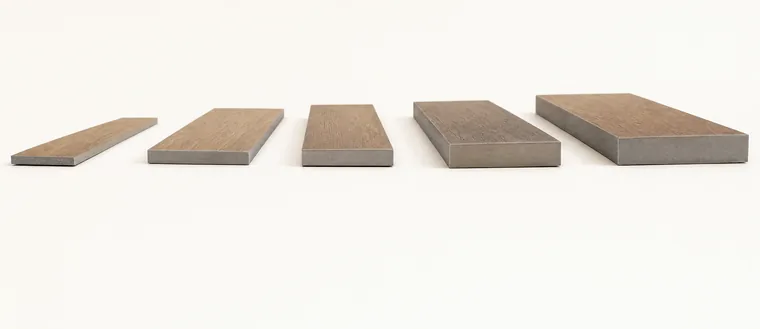
What a thicker plank comes bundled with
Thickness is the specification a buyer is offered, and it never arrives alone. The 839 products here resolve to only 0 specification combinations. A millimetre step is a wear-layer step and a plank-size step at the same time, and nothing observed here separates the three.
| Tier | Wear layer | Plank size | Products | Observations | Median $/sq ft |
|---|
Why a small job pays a premium nobody quotes
The waste allowance is a choice; whole-box packaging is not. Its cost depends on how well the box size divides into the job, and on a small floor it divides badly. At 100 square feet the box rounding adds between <0.1% and 47.3% on top of the waste allowance across the 81 box sizes in this catalogue. At 3,000 square feet the worst case is 1.5%. The premium is real, it is largest exactly where the budget is smallest, and no calculator we found models it.
| Area | After waste | Billed, best–worst box | Box rounding adds |
|---|---|---|---|
| 100 | 110 | 110–162 | <0.1–47.3% |
| 200 | 220 | 220–270 | 0–22.7% |
| 400 | 440 | 440–486 | 0–10.5% |
| 600 | 660 | 660–702 | 0–6.4% |
| 800 | 880 | 880–924 | 0–5% |
| 1,000 | 1,100 | 1,100–1,134 | 0–3.1% |
| 1,200 | 1,320 | 1,320–1,356 | 0–2.7% |
| 1,500 | 1,650 | 1,650–1,694 | 0–2.7% |
| 1,800 | 1,980 | 1,980–2,016 | 0–1.8% |
| 2,000 | 2,200 | 2,200–2,232 | 0–1.5% |
| 2,500 | 2,750 | 2,751–2,785 | <0.1–1.3% |
| 3,000 | 3,300 | 3,300–3,348 | 0–1.5% |
All areas in square feet. "Box rounding adds" is measured against the area after waste, not against the room, because the allowance is a deliberate purchase and this is the part nobody chose. One caveat sits under the whole section: 0 of the 1704 observations came from a listing that did not publish a box size, so the manufacturer's figure was used — how that is handled.
Which allowance applies to your layout
The tables above use the straight-layout allowance because it is the common case. A diagonal or herringbone install cuts more planks at an angle and wastes more of each one, so the allowance goes up before the boxes are counted — which means it compounds with the rounding rather than replacing it.
- Straight / stagger — add 10% (used in the tables on this page)
- Diagonal — add 15%
- Herringbone / chevron — add 17.5%
The price check tool applies whichever of these you pick, against the observed range for the specific product rather than the site-wide band used here.
What is not in these figures
- Installation labor — not observed, not estimated, not published anywhere on this site.
- Underlayment, transition strips, baseboard, and removal or disposal of the existing floor.
- Delivery and freight, which vary by order size and destination.
- Regional, in-store and negotiated pricing — every observation is a US national online listing.
- Porcelain and ceramic tile, carpet, trims, accessories and store brands.
- Availability. 0 of the 1704 observations carry a — sq ft minimum order, which the smallest jobs in the table above cannot meet.
A per-square-foot number quoted by a contractor usually bundles several of these. Subtract them before comparing, or the comparison is between two different things. Who publishes this and why.
How confident is this?
Release confidence is low, and the reason is sample depth rather than method. Of the 839 priced products, 27 carry three or more observations, 811 carry two and 1 rest on a single listing. The band on this page pools all 1704 observations, so it is firmer than any individual row — but those observations resolve to only 156 distinct prices, because a retailer prices a product line once and carries it across every colourway. Read the count as catalogue coverage, not as independent price checks.
Frequently asked questions
What does flooring cost per square foot?
How much does 1,000 square feet of flooring cost?
Does the price per square foot include installation?
Why am I billed for more square feet than my room measures?
Why is the same floor a different price at two sellers?
Can I actually buy at the cheapest observation you show?
Sources & last updated
Every price above was observed on at 3 of the 7 US online retailers named on the methodology page, and normalised to price per square foot. The box and waste arithmetic is the same engine the price check tool runs, documented in the methodology. Figures are re-published on every observation, so the totals in this table are for August 2026 and will move. Cite as: Floor Cost Estimator, "Observed US online retail prices for hard-surface flooring", observed August 19, 2026. Published by a materials-only flooring retailer that sells the category it prices. https://floorcostestimator.com/methodology